

TL;DR
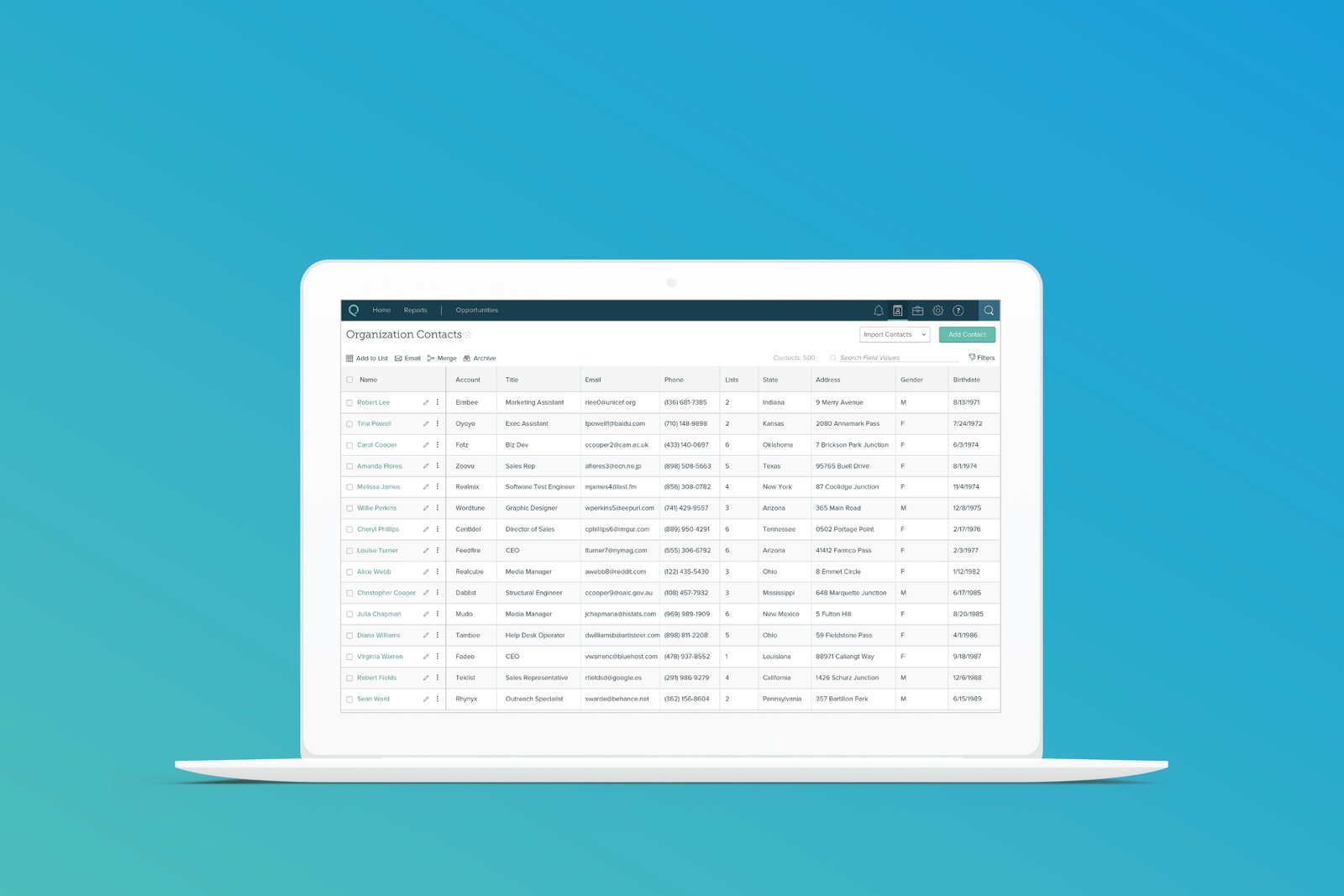
The Contact Gallery redesign lifted daily active users 40% and duplicates merged 34%. SalesforceIQ's back-end knew things about relationships its front-end could not turn into action. As Principal Product Designer, I carried the contact intelligence and data-quality surface from research through entity modeling to interaction design. I redesigned Contact Gallery around action, trust, and correction with multi-merge and a master contact model. I worked weekly with support, product, marketing, and engineering, and later fed early Einstein UX thinking in a consulting capacity. It shipped between December 2015 and April 2017.
The intelligence was there. Users could not act on it.
SalesforceIQ was early to the AI CRM story. The back-end captured relationships traditional CRM could not see. But intelligence in the back-end does not matter if the front-end makes users suspicious, confused, or tired.
Users still had to answer the same questions on every visit: Is this the right contact? Can I trust this record? What should I do next? What happens if I merge? Three long-standing customer issues had been open for months. The product was not translating what the AI knew into anything a sales user could act on without re-learning the app.
I worked weekly with support, product, marketing, and engineering so prioritization stayed honest about customer sentiment, then took the contact intelligence and data-quality surface directly.
What I did
- Researched pain points with AEs, customer success, and customers to anchor the redesign in actual friction, not assumed friction.
- Shipped fixes to three long-standing customer issues in the first month before opening a broader redesign conversation. The credibility bought license for the harder work.
- Reframed Contact Gallery from a display surface into a workflow surface: designed for what users needed to do (understand, trust, resolve), not for how to show more data.
- Introduced multi-merge and a master contact model, which meant rethinking the contact entity, not just adding a button.
The merge work is where the real fork showed up. Customers knew they had duplicates, so the obvious read was that merge was too hard to find or too tedious to run, and the fix was a faster, bulk-merge button. When I watched how people actually behaved, the friction looked less like effort and more like fear: merge collapsed several records into one in a single irreversible move, and users would not spend trust they could not get back. So I did not optimize the old action. I made merge composable and previewable. The user picks the master, chooses the default photo, and edits the assembled contact while every name, email, phone, and handle stays visible, all before anything is committed. Reframing merge from one irreversible action into a sequence of reversible, inspectable decisions is what moved the number, not a faster button.
Two things sat next to the merge work. After the PredictionIO acquisition I scoped the Einstein contribution honestly as adjacent, pre-product groundwork and worked it in a consulting capacity: how a confidence signal, a source, and a correction path should read when an AI surfaces an insight a salesperson has to act on. I did not own an Einstein deliverable, and I claim no metric for it. Alongside that, I mentored the first AI-focused designer on the team.
Multi-merge as a product model
Three frames of the decision the +34% lift sits on.
- 01 / 0301 · Pick master
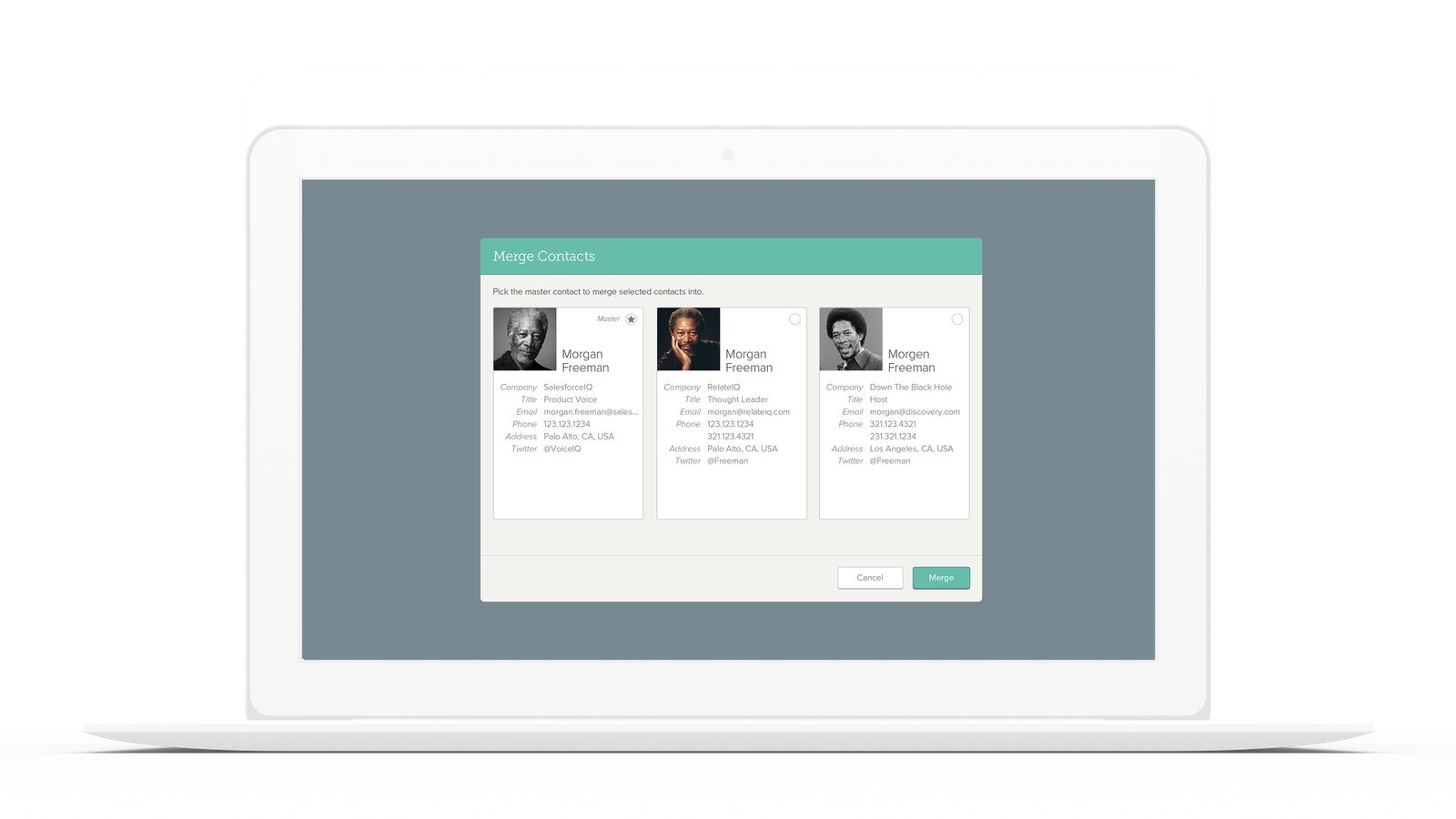
The first step exposed the model decision in the surface. Three contacts the system thinks are the same person, three sets of facts, one explicit Master selection. The product was not auto-merging on the user's behalf. - 02 / 0302 · Select photo
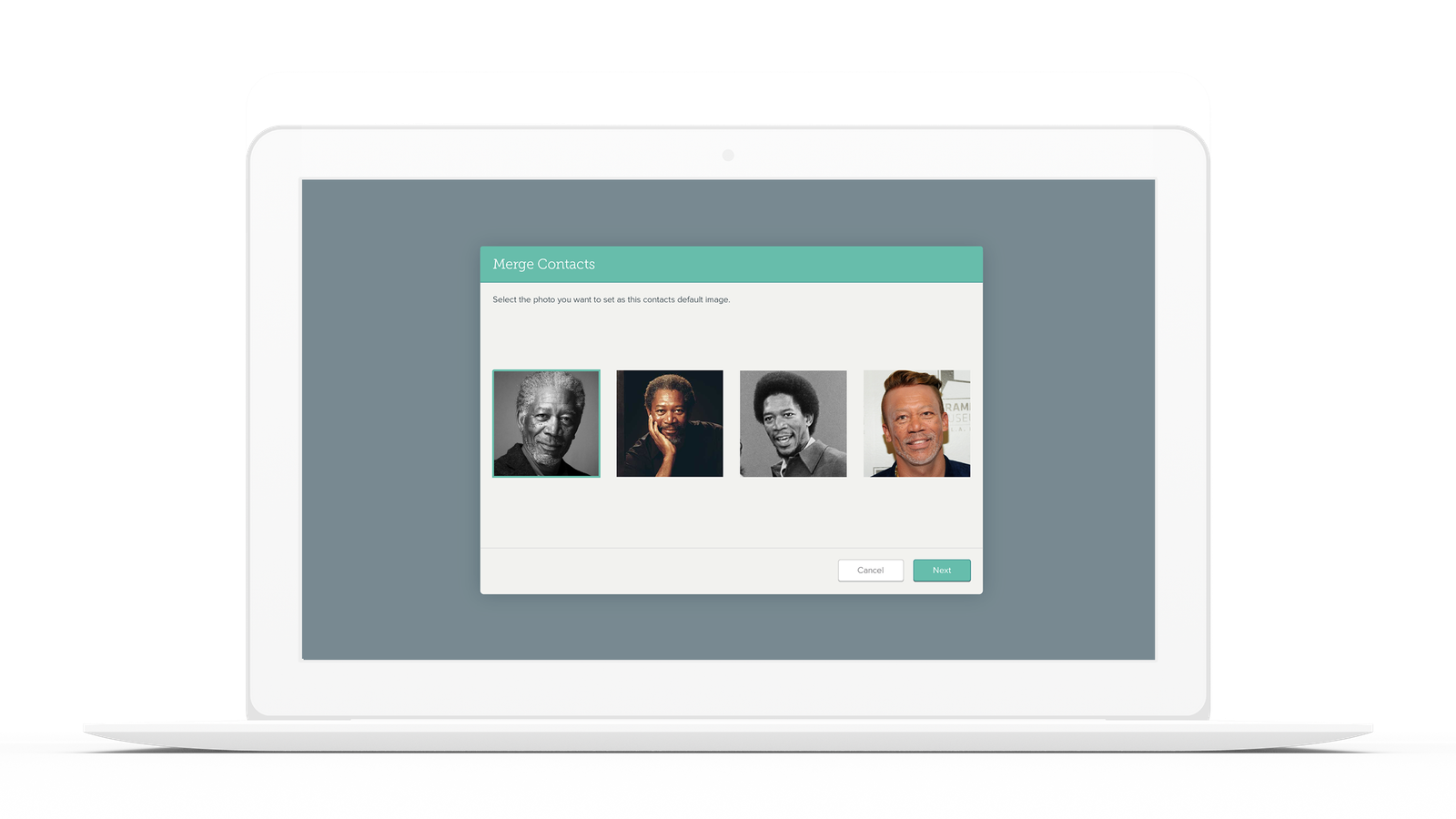
A separate explicit step for the default photo. The merge is composed from atomic decisions the user can reason about, not one large irreversible action. - 03 / 0303 · Edit details
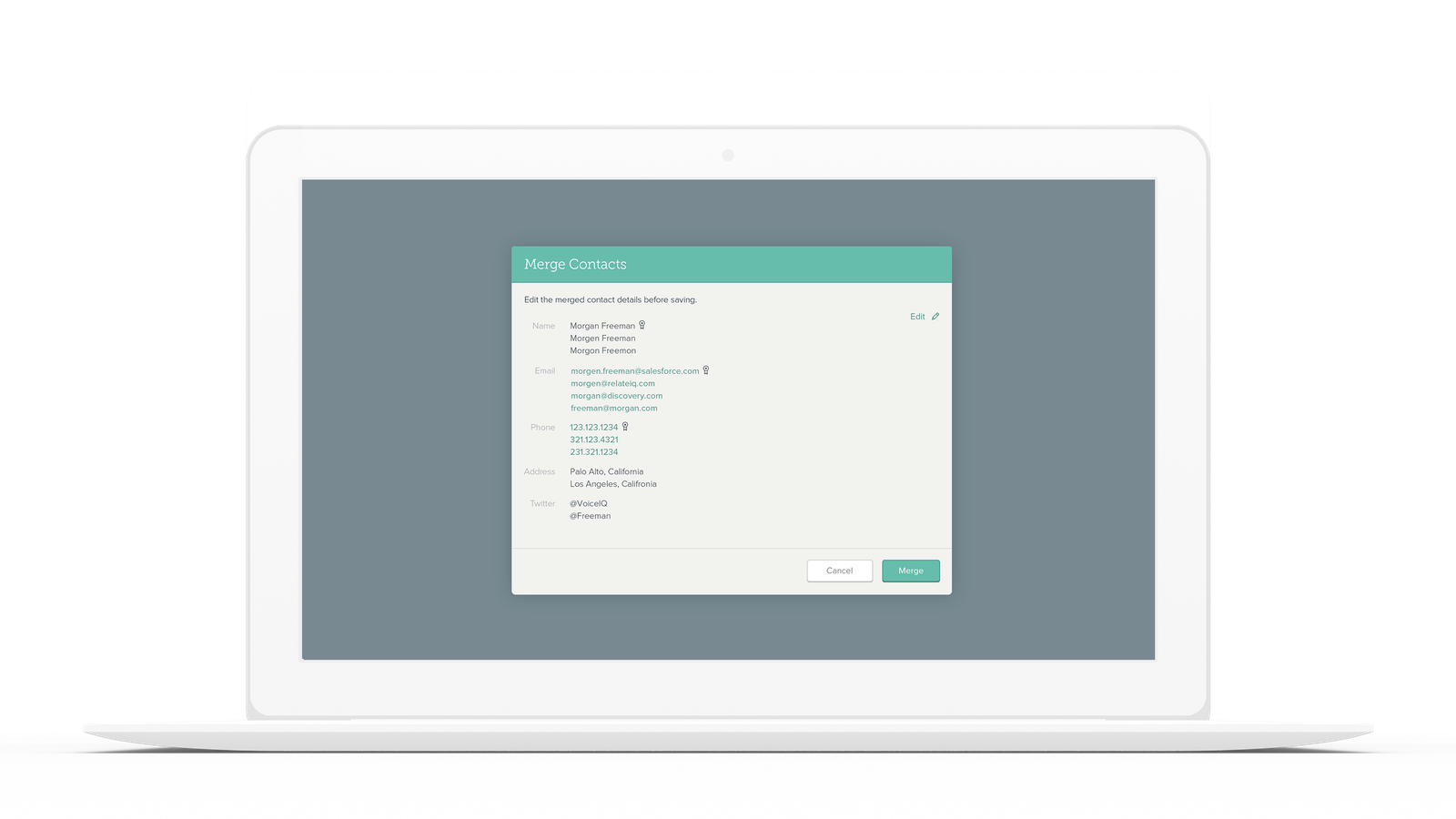
The composed contact stays editable before save, with every name, email, phone, address, and handle from the merge visible at once. The user owns the final shape, not the system.
What changed
Daily active users
After Contact Gallery redesign, 2017.
Plus a 34% lift in duplicates merged via the multi-merge model.
- Daily active users increased 40% after the Contact Gallery redesign.
- Duplicates merged increased 34% after multi-merge and master contact model shipped.
- Three long-standing, high-frequency customer issues closed inside the first month.
- Early Einstein consulting on confidence, source transparency, and correction loops fed forward as pre-product groundwork, before that work had a named owner.
Trust improved because users got clearer control over machine-captured data. AI earns trust by making the next action clearer, not by making the data denser.
Reflection
Trust was a control problem, not a data problem. The intelligence layer was already ahead of the experience, so the lift never came from surfacing more of it. It came from giving users reversible, inspectable control over machine-captured data. Closing three long-standing customer issues in the first month is what bought the license to rethink the contact entity at all. Had I opened with the redesign, I would have been arguing for a model change from zero standing. Credibility first, then the control work, then the number. In that order it held.
Where I would work differently. I ran the future-state visioning in parallel with the near-term product work instead of letting a clearer future thesis inform the near-term calls. That cost the redesign a through-line: the work landed as a set of good decisions rather than one argument built backward from where the product was headed. Next time I would settle the thesis first and let it discipline the near-term calls.
This work is a bridge between earlier CRM design and today's AI product work: the same problem of making machine intelligence something a person can trust and act on.